September 7, 2026 · 6 min
A home EV charging station: what the phrase actually names
Twelve thousand searches a month for something that, at a house, is not a station at all. It is a wall unit and a dedicated circuit, and the circuit is the project.
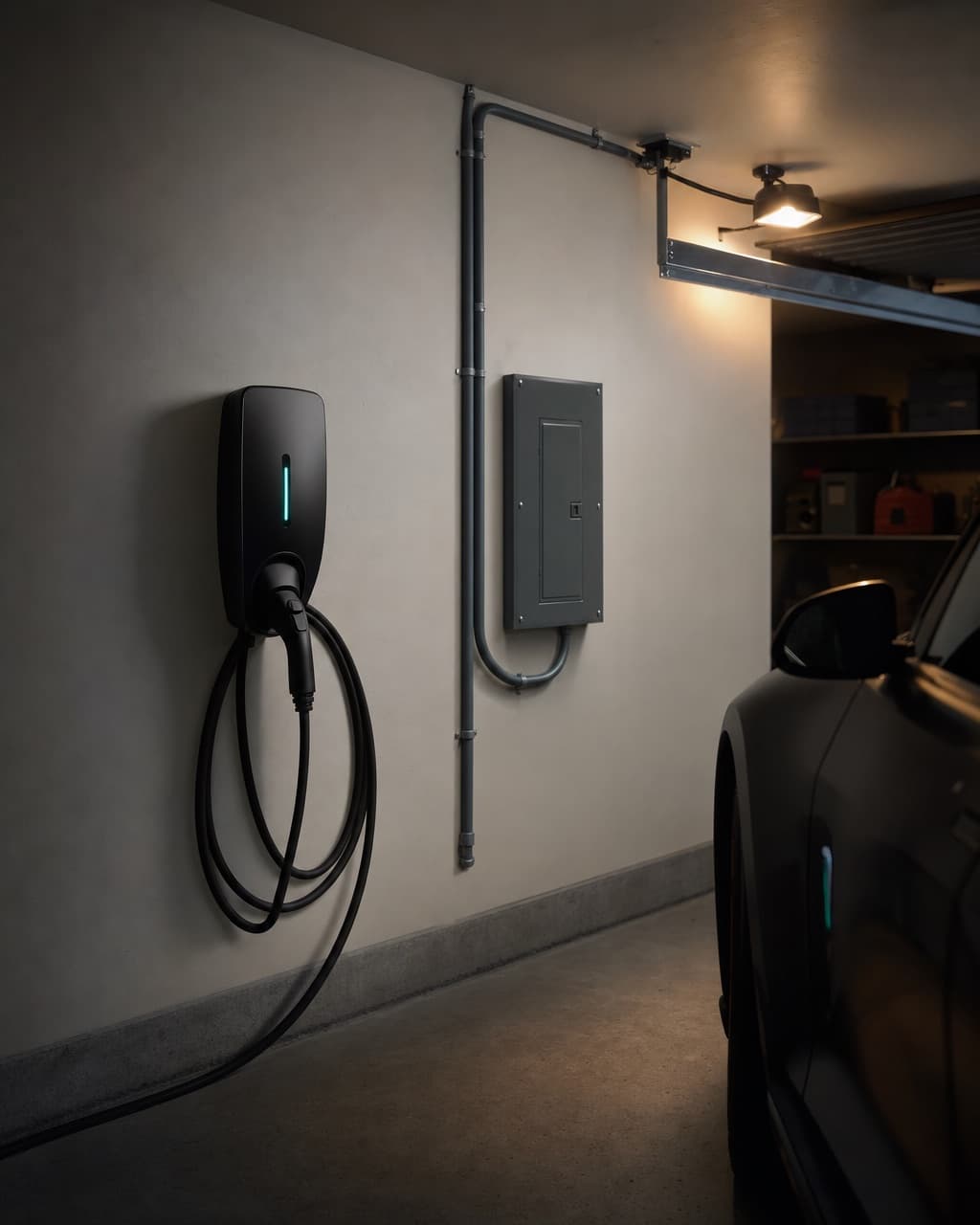
At 12,100 searches a month, this is the widest phrase in its whole cluster, and the word doing the misleading is “station”. It borrows the image of public infrastructure: a pedestal, a screen, a payment terminal. What the phrase names at a house is smaller and better: a wall-mounted unit about the size of a first-aid cabinet, wired to its own circuit, that fills the car while everyone sleeps.
At a house, the station is a unit plus a circuit
Two components, and they are not equals. The unit is the visible part, chosen from a catalogue and mounted in an afternoon. The circuit behind it is the actual project: a dedicated 240-volt run from the electrical panel to the parking space, sized for a load that draws near its rating for hours at a time. The unit can be swapped in minutes for as long as the building stands. The circuit is built once, which is why it deserves most of the attention, and why building it runs from first call to first charge.
Level 1 and Level 2, the only distinction that matters
Level 1 is the cord that came with the car, plugged into an ordinary 120-volt outlet. It works, slowly, and for a short commute it can genuinely be enough. Level 2 runs on 240 volts and charges several times faster, which is the difference between a car that recovers one errand overnight and a car that is simply full every morning regardless of yesterday. When people search for a home charging station, Level 2 is what they mean, whether they know the term or not.
The practical test is honest and simple: count the miles the car drives on a typical day, and ask whether an ordinary outlet replaces them in the hours the car is parked. Where the answer is yes, Level 1 is a legitimate choice. Where the answer is no, or where two drivers share one driveway, the dedicated circuit stops being a luxury and becomes the piece of the house the cars quietly depend on.
What it changes about owning the car
The public-station habit of planning charging stops disappears. The car leaves full every day, the low-battery arithmetic stops occupying space in your head, and public charging becomes something you do on a road trip rather than a chore you schedule. This is the part no specification sheet captures, and it is the reason the conversion rarely runs in reverse.
What your house needs to have
Two things, both establishable before any money is spent. First, spare electrical capacity: a load calculation on the panel answers whether the service can carry a continuous load on top of what already exists, and the answer is yes more often than people fear. Second, a workable route from the panel to where the car actually stops. Distance and obstacles on that route, not the unit, are what move the price, which is the whole subject of the cost drivers. The panel question is covered under panel and capacity.
What it does not require
No pedestal, no payment system, no separate service from the utility in the ordinary case, and no construction beyond the circuit itself. A common worry is that the house “is too old for this”. Age alone decides nothing: what matters is the panel and the route, and both are read in a single visit.
Where the unit should go
Wherever the cable reaches the charging port of the car parked in its real spot, without crossing a walkway or lying on the floor. That sounds obvious and is the detail most often improvised on the day. Ten minutes with the car in position, noting which side the port is on, settles it properly.
The first two facts we need
Where the panel is, and where the car stops. From those two facts follow the route, the load question and the quote. The full sequence of the work, from reading the panel to commissioning the unit, is laid out in the end-to-end guide, and the residential specifics live on home installation. The station, it turns out, is mostly a circuit.
Tell us where the car sleeps
One wall unit, one dedicated circuit, sized to your panel. We scope it before you buy anything.
Level 2 Charge Pro installs Level 2 charging equipment: the dedicated 240-volt circuit, the panel work it depends on, the cable run, and the inspection that closes the job.