July 30, 2026 · 7 min
What a Level 2 installation costs, and the four things that move the number
Two quotes for the same charger can differ by a factor of three. The charger is never the reason. Here is what is.
The single most common surprise in this work is the order of the numbers. People arrive having chosen a charger and having read its price, and they are expecting the installation to be a modest addition to it. In practice the device is usually the smallest line on the quote and the four items below are the ones that decide the total.
1. The distance from the panel to the parking space
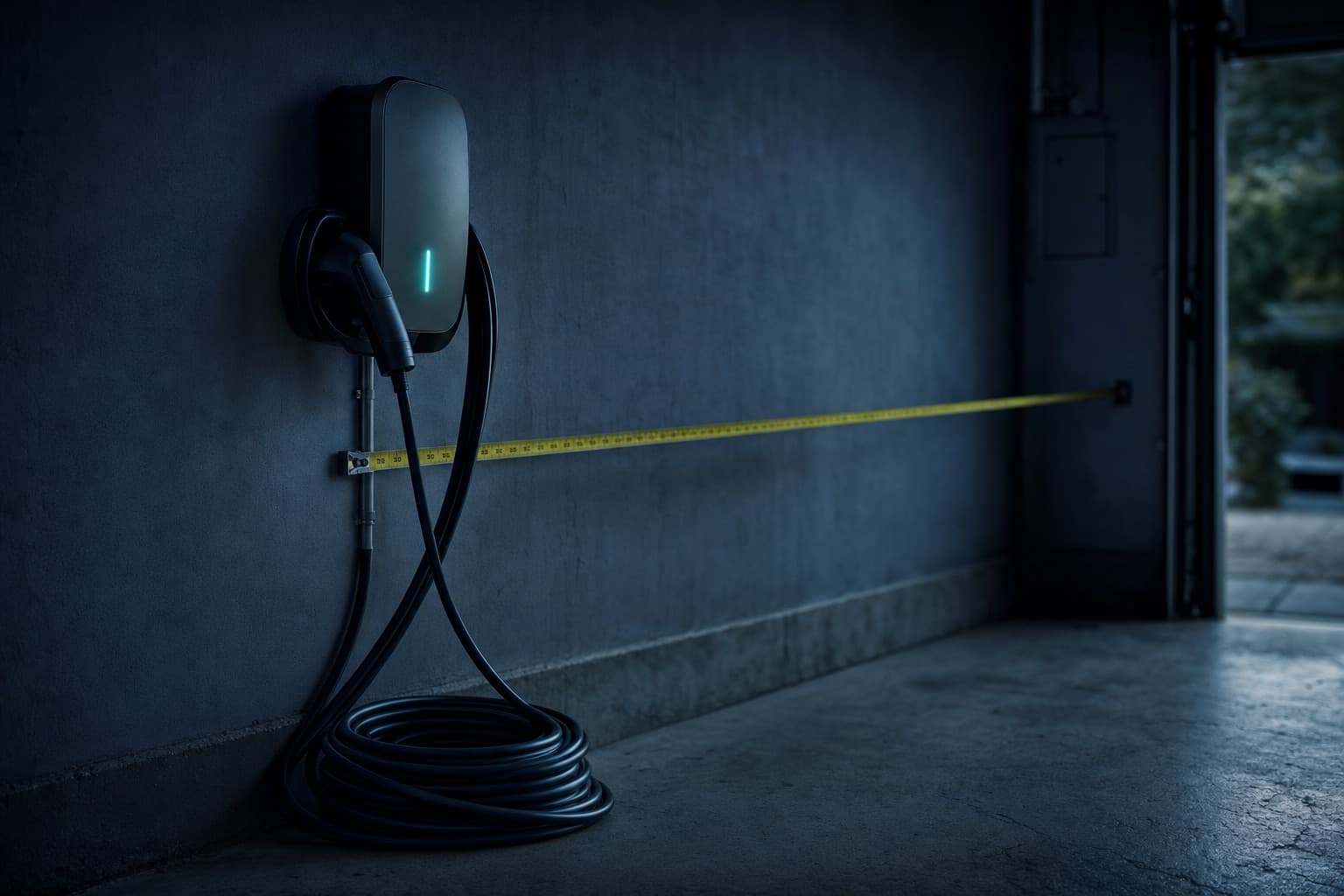
A charging circuit is a run of heavy conductors. Heavy conductors cost money by the foot, and the labour of getting them from one place to another costs more than the conductors do. A panel on the shared wall of an attached garage is a short afternoon. A panel in a basement on the far side of the house, with a detached garage at the end of a driveway, is a different project entirely, because the circuit now has to leave the building, cross open ground and re-enter.
The route matters more than the straight-line distance. Twenty feet through an unfinished basement ceiling is cheap. Twenty feet through a finished, insulated, occupied wall is not, because most of the work is opening it and putting it back. This is covered in detail under location and cable run.
2. Whether the panel has room, electrically and physically
Two separate questions hide inside the phrase “room in the panel”. The first is physical: are there two adjacent empty slots for a double-pole breaker. The second is electrical: after a load calculation, does the service have enough spare capacity to carry a continuous load for hours at a time.
A panel can be physically full and electrically fine, which is a cheap problem. It can also be half empty and electrically maxed out, which is not. When capacity is genuinely short there are three routes: a load management device that sheds the charger when the house draws hard, a lower charging output set at commissioning, or a service upgrade. Only the third is expensive, and it is the one that gets quoted first by installers who have not done the calculation, which is the first thing to test when you are working out how to judge an electrician. See panel and capacity.
3. What the run has to pass through
Drywall, joists, brick, stucco, a concrete slab, a driveway. Each is a different trade and a different day. Trenching under a driveway to reach a detached garage is the item that most often doubles a quote, and it is also the item most often absent from the cheapest of three bids, which is why that bid looks cheapest. Which of those cases you are in is mostly decided by the garage, as set out in installing a charger at a house.
4. The permit and the inspection
In most jurisdictions this work is permitted and inspected. The permit fee itself is usually minor. What is not minor is the schedule: an inspection has to be booked, and in some jurisdictions the utility has to be notified before the load is added. A quote that omits the permit is not a cheaper quote, it is an unpermitted installation, and it becomes visible the day the property is sold, a claim is made, or a rebate is claimed against documents that do not exist, which is the subject of what rebate programs pay against. See permits and planning.
The six questions that make two bids comparable
Quotes for this work are rarely written the same way, which makes them hard to read side by side. These six questions force them into the same shape:
- Is a load calculation included, and will I be shown it?
- What is the assumed route, and what happens to the price if the route changes?
- Is the breaker, the conductor size and the protection specified in writing?
- Is the permit included, and who books the inspection?
- Is the charger hardwired or on an outlet, and why that one here?
- What is excluded? This is the question that finds the trenching.
A bid that answers all six is comparable to another bid that answers all six. Anything else is a guess wearing a number.
Why no dollar figure appears on this page
Because it would be invented. The four items above vary by an order of magnitude between two houses on the same street, and any single number published here would be wrong for almost every reader who found it. What we can do is look, and then commit.
Have the scope priced before you buy hardware
Tell us the ZIP code and where the car parks. The panel is ours to establish, not yours to guess.
Level 2 Charge Pro installs Level 2 charging equipment: the dedicated 240-volt circuit, the panel work it depends on, the cable run, and the inspection that closes the job.