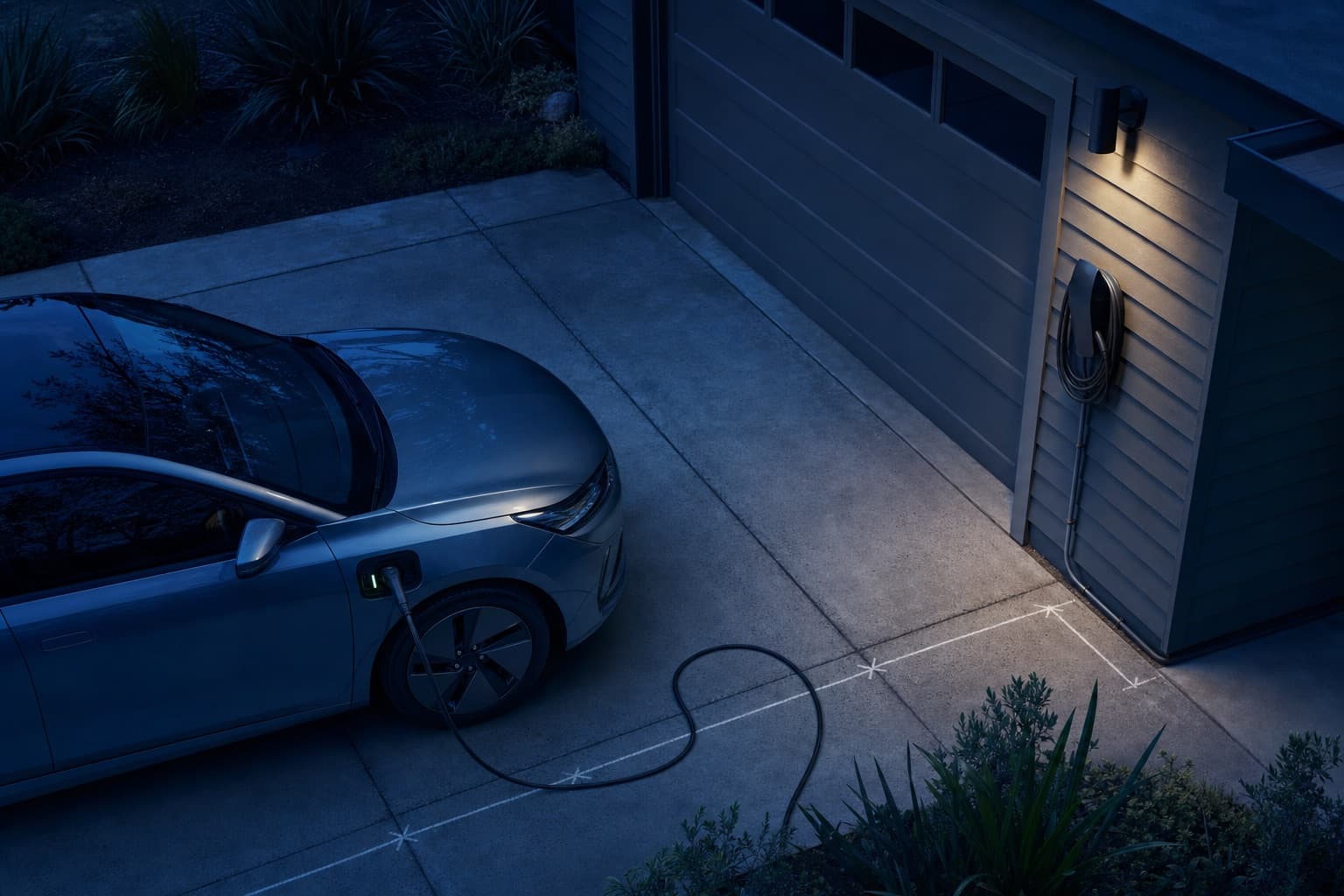
Where the charger goes, and why the distance to the panel is the whole project
The charger goes where the cable can reach the car's port from the position the car actually parks in. Everything else, the tidy wall, the spot beside the panel, the place it looks best, is a preference that gets paid for twice if it is wrong.
Start from the car, not from the wall
Charging ports are not in the same place on every vehicle. Front left, front right, rear quarter, the position decides which side of the parking space the cable has to reach, and whether it has to cross in front of or behind the vehicle to get there.
Two practical checks before anything is mounted. Park where you actually park, not where you would park for a photograph. Then walk the cable route with a tape measure, at the height the unit will be mounted, allowing for the cable to hang rather than stretch.
A cable pulled taut across a walkway is the most common regret in this category, and it is entirely avoidable at the planning stage.
Height, reach and the second vehicle
- Mounting height is a compromise between cable weight, connector reach and keeping the unit clear of damage. Manufacturers publish a recommended range, follow the one for your equipment rather than a general rule.
- Cable length is specified with the equipment. Longer is not automatically better: a long cable that lives on the floor gets driven over.
- If a second vehicle is likely, decide now whether it parks on the same side. Positioning the unit centrally, between two spaces, is often the cheapest future-proofing available.
- Where a second charger may follow, running an oversized conduit while the wall is open costs very little compared with opening it again.
Routes, in order of cost
Along an unfinished wall
The cheapest case, and the reason a charger in an unfinished garage next to the panel is close to trivial work. Conduit is surface-mounted, nothing is opened, nothing is repaired.
Through finished space
Cost follows what has to be opened and put back. A route through a basement ceiling that is already exposed is cheap. The same distance through a finished, occupied floor involves drywall, paint and someone else's schedule.
Outdoors along the building
Weather-rated conduit and fittings, penetrations sealed properly, and a mounting arrangement designed for exposure. Straightforward work that is simply more work than the indoor equivalent.
Under ground to a detached structure
The step change. A trench of specified depth, conduit, backfill, and reinstatement of the driveway, path or lawn on top. It also raises questions about what else the detached structure is fed by, and whether that feed can carry a charger at all.
Common positions, and what each costs you later
- Next to the panel because it is easy: cheap to install, and a permanent daily inconvenience if the car does not park there.
- On the far wall for tidiness: a long run through finished space, paid once, for an aesthetic gain.
- Outside, on the driveway side: fine, provided the equipment is rated for it and the cable is not left on the ground.
- In the middle of the garage bay: often the best compromise for two vehicles, and it is worth checking that a person can still walk past.
None of these is wrong. They cost different amounts, and the difference is predictable, which is exactly the sort of thing that belongs in a quote rather than in a conversation afterwards. See what drives the cost.
Frequently asked
Can the charger be installed outside?
Yes, with equipment rated for outdoor use and an installation designed for weather. Whether the run to it is trivial or a trench depends on where the panel is.
How long a cable do I need?
Enough to reach the port from the parked position, with slack, measured, not estimated. Buying a longer cable to compensate for a badly placed unit works until the cable is on the floor.
Can one charger serve two cars?
One at a time, if both can reach it. Charging two simultaneously means two circuits or equipment designed to share one, which brings the service capacity question back to the front.
Last reviewed July 29, 2026.
Describe the parking before anyone mounts anything
Where the car sits, which side the port is on, and where the panel is. Ten seconds of information that changes what the job is.
Level 2 Charge Pro installs Level 2 charging equipment: the dedicated 240-volt circuit, the panel work it depends on, the cable run, and the inspection that closes the job.