September 18, 2026 · 6 min
An outdoor home EV charging station: what changes when there is no garage
Charging outdoors is normal and durable when four details are respected. All four are decided before anything is mounted.
A measured 30 searches a month puts this at the quiet end of its cluster, but the people asking have a concrete situation: the car sleeps outside, and every glossy photo of home charging shows a garage. So, first, the reassurance, which happens to be true: charging equipment is designed to live outdoors, connectors are weather-rated by design, and charging in rain is safe. What outdoor placement changes is not whether the project works but four details of how it is built.
1. The enclosure rating is the starting point
Every component that lives outside, the unit, any disconnect, any receptacle and its cover, has to be rated for outdoor exposure, and the rating has to match the exposure: a wall under a deep eave and a post in open weather are different situations. This is a selection question, decided when the equipment is chosen, and it quietly disqualifies part of the catalog: it is one of the properties that matter in choosing a home charging unit. What the ratings must satisfy is summarised under requirements.
2. Hardwiring earns its keep outdoors
The plug-versus-hardwired question tilts outside. A receptacle outdoors needs protection and covers that a receptacle in a garage does not, some jurisdictions would restrict or condition outdoor receptacles for this use, and the plug connection is the component most exposed to moisture and temperature swings. Hardwiring removes all of that in one decision. The general trade-off is set out in hardwired or a 240-volt outlet.
3. The car is a bigger threat than the weather
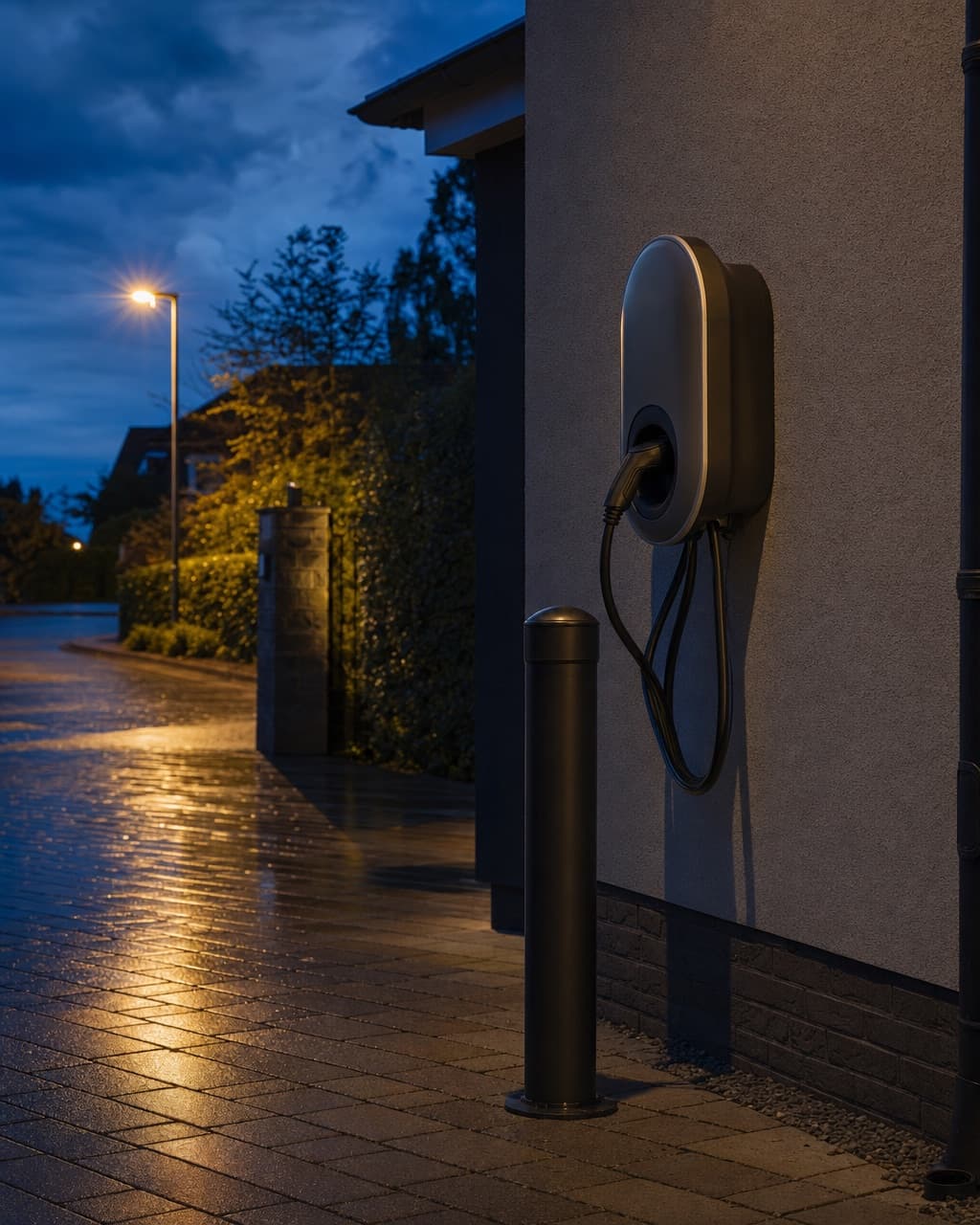
Rain falls on the enclosure, which is built for it. A reversing car arrives at bumper height with none of the enclosure’s patience. Mounting on a wall the car cannot reach, or behind a bollard where it can, is worth more than any upgrade to the unit itself. Height matters too: above splash and snow line, at a position where the cable hangs to the port without lying across paving.
4. The cable is the part that ages
The unit is sealed; the cable is handled daily, dropped, driven over and left in puddles. Outdoors, cable management stops being cosmetic: a holster or hook that keeps the connector off the ground and the cable off walkways is the difference between equipment that lasts and equipment that is replaced early, usually with the weather taking the blame.
Heat, cold and what they do to charging
Cold slows charging, because the battery protects itself, and heat asks more of the electronics. Both effects are managed by the car and the unit without intervention, and both matter less on Level 2 overnight charging than at any fast charger, since the car has hours to work with. What that patience is worth against paying for speed is the subject of home charging versus a public station. Outdoor placement does not change what the equipment can do; it changes how often the conditions test it.
The route can actually be shorter outside
A parking spot against an exterior wall is sometimes closer to the panel than any point inside a garage would be, with the run staying on or in the wall the whole way. A spot across paving is the opposite case, where trenching enters the scope. Either way the route is walked and priced before anything is bought, as laid out under location and cable run.
What an inspection would look at outdoors
Where the jurisdiction requires a permit and inspection, and for fixed wiring most would, the outdoor items on the list are exactly the four above: ratings matched to exposure, protection appropriate to the termination, mounting that survives the site, and a route built to code depth where it is buried. An installation that respects them reads as boring to an inspector, which is the best review this work can get.
More advice
Describe the outdoor spot
Driveway, carport or bare wall: tell us where the car stops and what the wall is made of.