August 13, 2026 · 6 min
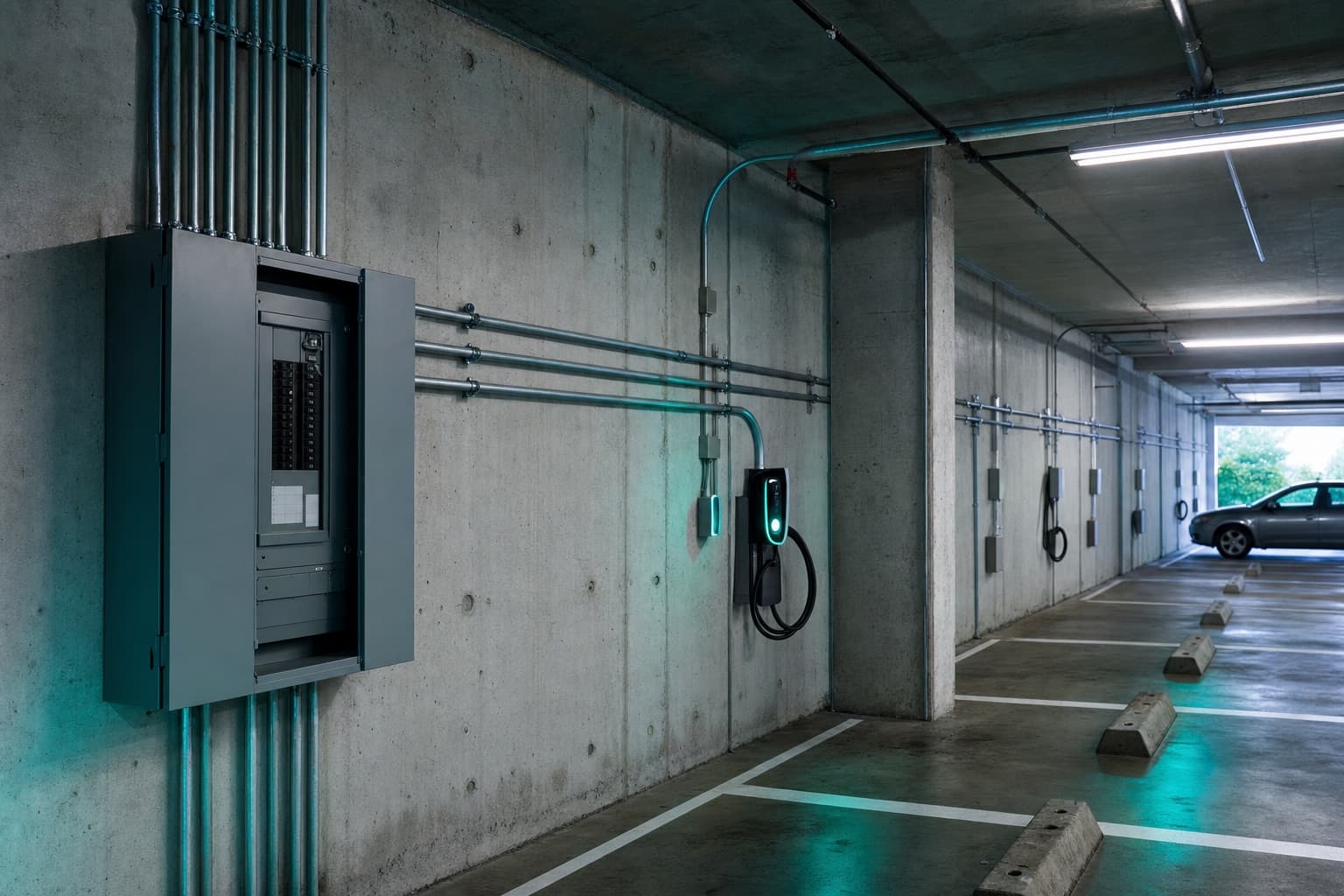
Getting a charger into an apartment building garage
The electrical problem is solvable and predictable. The consent problem is the one that stops projects, and it is first.
This query has the highest cost per click of anything in its cluster and one of the lowest volumes: 30 searches a month at $24.38. That combination describes a small number of people with a real and expensive problem. Almost all of them discover the same thing, which is that the hard part is not electrical.
The order that actually works
Approval, then metering, then electrical. Projects that start with the electrical work are the ones that stall, because the panel schedule and the load calculation depend on decisions that only the board or the owner can make. Holding the three stages together under one party is what a full installation service is for.
1. Who has to approve, and of what exactly
A charger in a shared garage touches common property: a wall, a ceiling, a conduit route, and usually the building’s electrical service. That places it in front of whoever controls common property, which is a board, an owner or a management company. Several states have passed legislation limiting an association’s ability to refuse outright, and the specifics differ enough that the applicable rule has to be read for the building in question rather than assumed.
What an approval needs to cover, and what boards most often ask for: the mounting location, the conduit route, who pays for the electricity, who owns the equipment, who insures it, and what happens when the resident moves out.
2. Metering: whose electricity is it
The question that sinks the most proposals. Three common answers, each with a consequence:
- From the unit’s own meter.Cleanest billing, hardest wiring: the circuit has to reach the parking space from that unit’s panel, which in a large building can be a long way.
- From house power, with sub-metering. Easier wiring, and the equipment reports consumption per user so the association can bill it. Requires the association to operate a billing process, which is a decision rather than a detail.
- From house power, unmetered. Simplest, and the fastest way to a dispute with residents who do not drive.
3. Shared capacity, which is usually the good news
A building rarely has spare capacity for every parking space to charge at full output at once. It almost always has enough for every space to charge overnight, because cars are parked for far longer than they need. Load management divides the available capacity between the units that are actually drawing, and it is what makes a full garage feasible without a service upgrade. At the smallest scale it is the same trick two chargers use to share one circuit, described in installing a Tesla Wall Connector.
The practical consequence is that a building should plan the infrastructure once, for more spaces than are needed today, and add units to it as residents ask. Conduit installed once for eight bays is a fraction of the cost of installing for one bay eight times, because route and distance drive the number here exactly as they do in the cost drivers at a house. That planning is what multifamily charging covers in detail.
What to bring to the first conversation
- Whether you are a resident, an owner, a board member or a manager.
- How many bays might eventually need a charger, not just yours.
- Whether the garage has its own electrical room and where it is.
- Whether the association has already refused a request, and on what grounds.
Describe the building
Owner, board or manager, we will tell you which approval has to come first and what it needs.
Level 2 Charge Pro installs Level 2 charging equipment: the dedicated 240-volt circuit, the panel work it depends on, the cable run, and the inspection that closes the job.