October 8, 2026 · 6 min
Electrical subpanel installation: what a second panel solves for a charger, and what it does not
A subpanel adds room. It does not add power. Most of the confusion around this project comes from treating those two as the same thing.
“Electrical subpanel installation” is searched about a thousand times a month in the United States, and its shorter twin, “subpanel installation”, a little more often. Behind both there is usually one of three situations: a main panel with no free slots, a garage or outbuilding far from the house, or a project that will add several circuits in one place. A charger is often the trigger for all three. Here is what a subpanel actually does, and the one thing people expect from it that it cannot do.
What a subpanel is
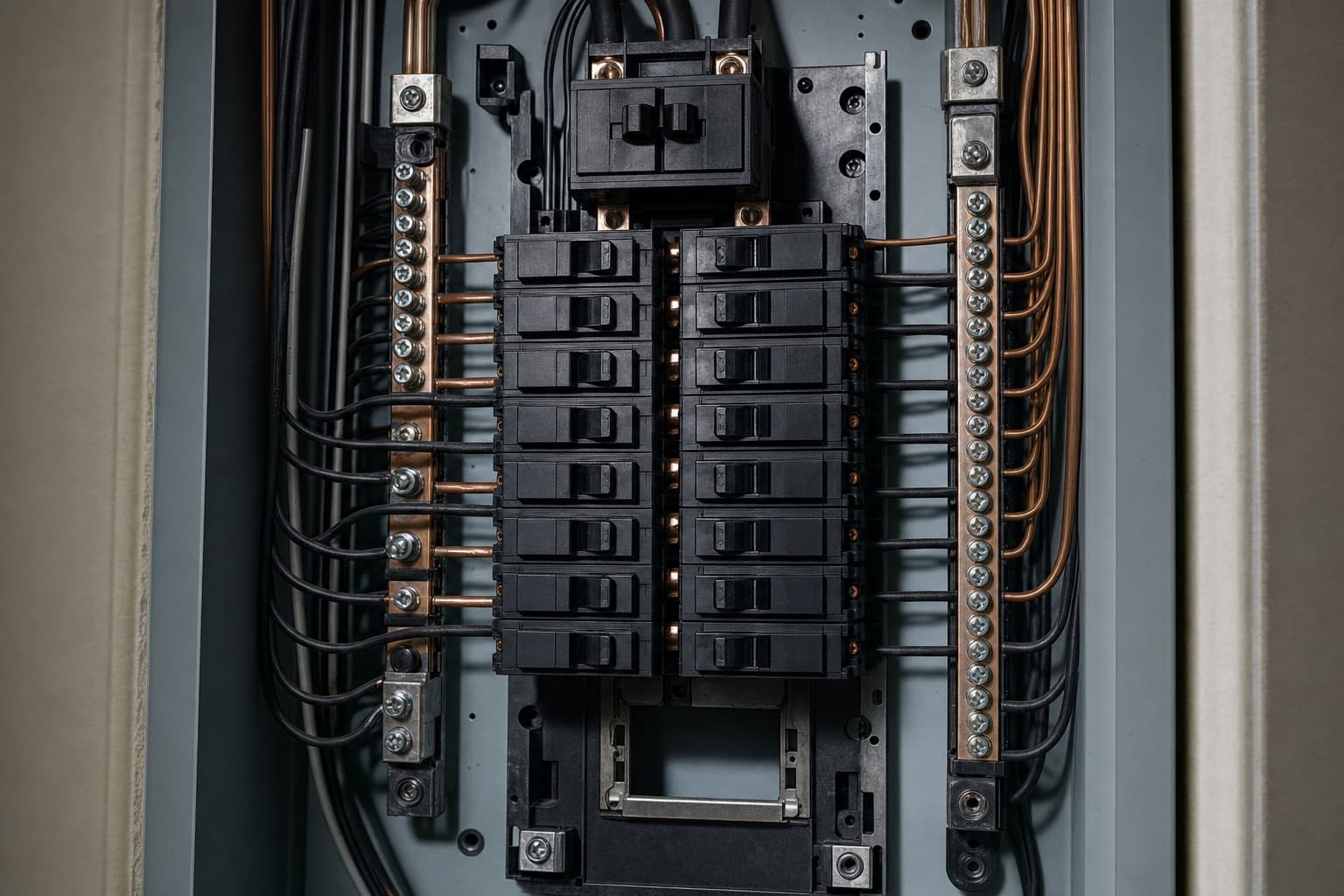
A subpanel is a second distribution panel fed from a breaker in the main one. The feeder, a set of heavy conductors, runs from that breaker to the new panel, and the new panel distributes it to its own circuits. Electrically it is a branch of the main panel, not a new supply. Everything it delivers passes first through the main breaker and the service the utility provides.
Room is not capacity
This is the point that decides most projects. A main panel that is physically full has a slot problem, and a subpanel solves a slot problem well. A service that is electrically short, where the load calculation shows the house cannot carry a charger running for hours on top of everything else, has a capacity problem, and a subpanel does nothing for it. The charger draws the same current through the main breaker whichever panel its own breaker sits in. Telling the two apart is the first step of every project, and the method is set out under panel capacity check.
Where a subpanel earns its place
Three cases. A detached garage or a parking space far from the house, where one feeder crossing the distance replaces several long circuits and leaves room for a light, a door opener and a second charger later. A main panel that is full but electrically sound, where moving a group of circuits to a subpanel frees slots without touching the service. And a renovation adding several circuits to one area, where a local panel keeps the runs short. In each case the subpanel is a distribution answer to a distribution problem.
What the feeder decides
The size of the feeder breaker and conductors is set by what the subpanel will carry, calculated, not guessed, and by the distance, since a long run loses voltage and may need a larger conductor than the current alone would require. The route matters as much as on a charger circuit: through an open basement ceiling it is a modest job, across a driveway it is a trench. The same reasoning is applied to the charging circuit itself under location and cable run.
Neutral and ground: the detail inspectors look at
In a main panel the neutral and the ground are bonded together. In a subpanel they are kept apart: separate bars, the bonding screw or strap left out, four conductors in the feeder rather than three. A detached building usually needs its own grounding electrode as well. Getting this wrong does not stop anything from working, which is why it survives in amateur work, and it is one of the first things an inspector opens the cover to check.
Permit and inspection
A subpanel is a new feeder and a new panel, which in nearly every jurisdiction means a permit and an inspection. When the subpanel exists to serve a charger, both belong to the same application and the same visit, rather than two projects inspected twice. How that is sequenced is described under permits and project planning.
When the answer is something else
If the calculation shows the service is short, the options are the ones described for any charger: a load management device, a lower output set at commissioning, or a service upgrade. A subpanel can be part of the upgrade, never a substitute for it. If the main panel is full only because of a few tandem-capable slots left unused, the answer may be smaller still. Each of these is a different scope, and choosing between them before any hardware is bought is the cheapest decision in the project.
What to send us
A photo of the main panel with its cover on and its label legible, the rating on the main breaker, the large appliances in the house, and where the car parks relative to the panel. From that we can say in writing whether the problem is room, capacity or distance, and which of them a subpanel would actually solve.
More advice
- October 5, 2026A 200-amp electrical panel upgrade for a home with an EV: when it is the right target, and when it is not
- October 2, 2026Do you need a permit to upgrade an electrical panel? What the inspection checks, and what the missing paper costs later
- September 30, 2026Electrical panel upgrade services: what a proper engagement includes, from load calculation to final inspection
Find out whether a subpanel is the answer
Send a photo of the main panel and tell us where the car parks. We say in writing whether the problem is room, capacity or distance.